Coming Soon
Scheduled to release on October 1, 2026
The Spy in the Statehouse: People v. O'Grady & Insider Cyber Trespass
If an employee holds legitimate, authorized login credentials to a confidential government database, can using those exact same credentials to search private records make them guilty of criminal trespass?
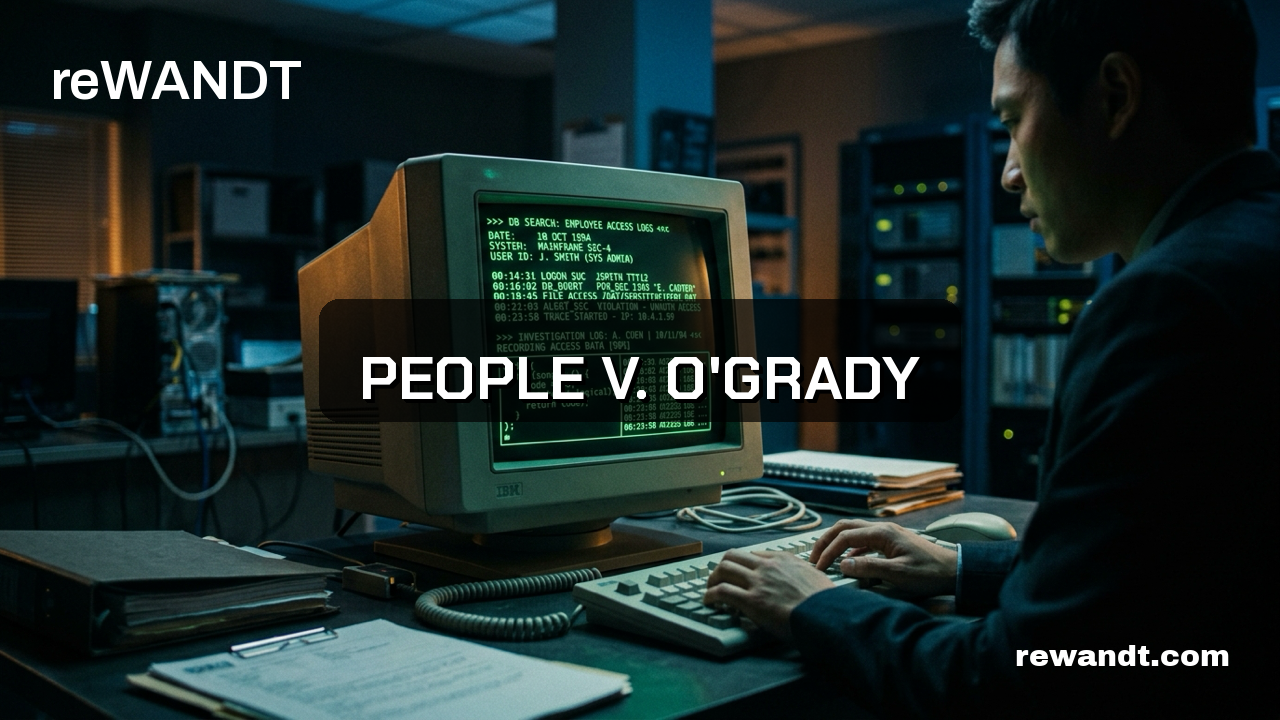
If an employee holds legitimate, authorized login credentials to a confidential government database, can using those exact same credentials to search private records make them guilty of criminal trespass? In August 1996, a personal feud in upstate New York spilled over into the New York State Department of Taxation and Finance. An employee used her personal terminal credentials to run unauthorized queries against the confidential tax profiles of her sister's romantic rival and family members. When indicted for felony Computer Trespass under New York Penal Law Section 156.10, she mounted a vigorous defense: her credentials were valid, and the state had no eyewitness proving she was the one typing at the keyboard. In this episode of reWandt, Professor Adam Scott Wandt examines People v. O'Grady (263 A.D.2d 616). We explore how the New York courts defined the scope of authorization, how circumstantial digital audit trails establish criminal attribution beyond a reasonable doubt, and how this landmark ruling acts as the vital legal shield protecting your personal medical, financial, and tax privacy from rogue corporate and government insiders in everyday modern life. Explore more deep dives at https://reWandt.com #reWandt #CyberLaw #DigitalForensics
Key Takeaways & Core Ideas
- ▪How the 1996 investigation at the NYS Department of Taxation and Finance established that valid credentials do not confer legal authorization for personal snooping.
- ▪The forensic attribution ruling: why the Appellate Division held that digital audit logs, duty hours, and human motive were sufficient to prove identity without an eyewitness.
- ▪The intersection of NY Penal Law § 156.10 with federal CFAA standards and the Supreme Court's landmark decision in Van Buren v. United States.
Source Excerpt
"If an employee holds legitimate, authorized login credentials to a confidential government database, can using those exact same credentials to search private records make them guilty of criminal trespass?"